Fleet management is not only about knowing where a vehicle is at a given moment. For many operational decisions, managers need to understand what has already happened: which route was taken, how the journey developed and what information can be taken from that activity.
When this history is not clearly available, questions become harder to answer. Did the team pass through the expected location? Did the vehicle follow the planned route? Does the journey match the operational plan? Without an organised view, these answers may depend on calls, messages or manual checks.
This is where route history becomes important. By reviewing completed journeys on a map and through graphs, managers can analyse operations with more context. The Quatenus Time Machine feature was designed to support this process, helping teams review vehicle routes and turn movement into useful management information.
In the daily activity of a fleet, every vehicle generates information through its movements. These journeys may be connected to field teams, customer visits, operational routes, deliveries, technical assistance or other external activities.
The challenge appears when this information is not easy to review after the journey has taken place. The current vehicle position only shows one part of the operation. Route history helps explain how the vehicle reached that point.
Without simple access to completed routes, managers may struggle to reconstruct the day’s activity. This increases dependence on manual confirmations and can make analysis slower. In operations with several vehicles and field teams, this lack of context can create more questions and delay decisions.
Reviewing route history helps reduce that uncertainty. Instead of looking only at the present moment, managers gain a more complete view of vehicle movement across the analysed period.
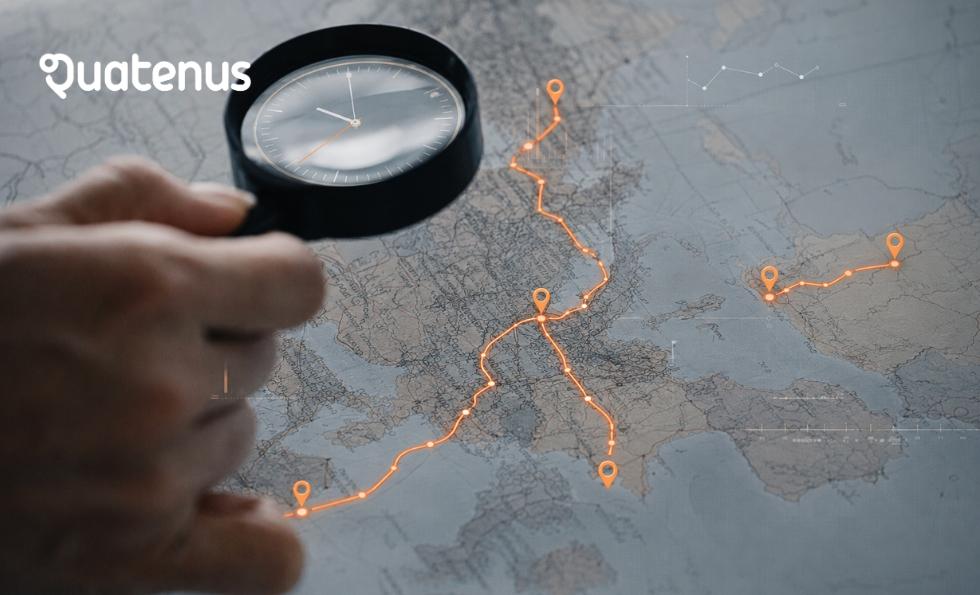
The Quatenus Time Machine feature allows users to review routes completed by a vehicle, displaying that information on a map and through graphs. This combination helps managers follow route history in a more visual and organised way.
The map shows the journey across the territory. The graphs support the reading of information associated with the route. Together, these elements make it easier to interpret completed activity and better understand the operational behaviour of the vehicle.
The feature is particularly useful when managers need to review a specific period, validate a journey or understand the sequence of movement of a vehicle. Instead of working with scattered information, they gain a centralised view of the route.
The value of Time Machine lies in its ability to provide context about what has already happened. It is not only about seeing a line on a map. It is about better understanding fleet activity and supporting decisions with a clearer view of history.
Route analysis becomes more useful when managers can connect location, sequence and visual information. Time Machine supports this analysis by displaying completed routes on a map and providing graphs associated with the journey.
This logic makes route review more intuitive. The map helps show where the vehicle travelled. The graphs help follow journey information across the selected period. When these two elements are viewed together, analysis no longer depends only on isolated points.
For a fleet management team, this type of review can be useful in several moments: checking a vehicle’s history, analysing a route completed by a field team or clarifying questions about a specific journey.
The advantage lies in being able to look at operations through a time sequence. Managers can analyse the route as an organised story, rather than trying to rebuild movement from scattered information.
Route history can support several common fleet management situations. One of them is the daily analysis of vehicle activity. By reviewing completed routes, managers can better understand how the operation developed and identify points that deserve attention.
Another application is the monitoring of field teams. When a team moves throughout the day, route history makes it possible to review the movement sequence and better frame the completed activity. This helps answer internal questions and improve operational reading.
It can also be useful for validating routes in operations with prior planning. By reviewing what was completed, the company gains more clarity about execution and can compare available information with what had been planned.
In all these cases, Time Machine does not replace the manager’s analysis. It supports that analysis with visual, organised and easier-to-review information.
The main benefit of reviewing route history is visibility. When managers can review journeys on a map and through graphs, they have more context to interpret fleet activity.
This visibility can support operational decisions, help clarify questions and reduce dependence on manual checks. It also contributes to clearer communication between management, field teams and operational leaders.
For the company, route history helps turn movement into information. The vehicle is no longer only a point on the map. It becomes a sequence of activity that can be analysed.
In fleet management, this type of context matters because it brings decisions closer to operational reality. The clearer the view of what happened, the easier it becomes to monitor, adjust and improve operations.
Reviewing completed routes should not be seen only as a way to confirm whether a vehicle passed through a specific location. Its greatest value lies in understanding the sequence of activity.
This view helps managers understand the route within a broader context: operation, team, planning, journey and decision. When history is easy to review, the company gains greater ability to analyse field work with clarity.
Discover the Quatenus Time Machine feature
See how route history can support clearer, better-informed fleet management that is closer to the reality of field teams.
Ask for DemoFAQ
Time Machine is a feature that allows users to review routes completed by a vehicle, displaying that information on a map and through graphs. Its purpose is to make route history easier to analyse and support fleet management with more context.
Reviewing route history helps managers understand what happened during the operation. Instead of analysing only the current position of the vehicle, it is possible to review the journey sequence and gain a more complete view of field activity.
Yes. By showing the routes completed by vehicles, Time Machine helps provide better context for the activity of field teams. This can support daily analysis, journey validation and responses to operational questions.
No. According to the available briefing, Time Machine shows completed routes on the map and also presents graphs to support journey analysis.
Route history can support decisions related to operational monitoring, fleet management and field team analysis. It helps managers work with more contextualised information about activity that has already taken place.